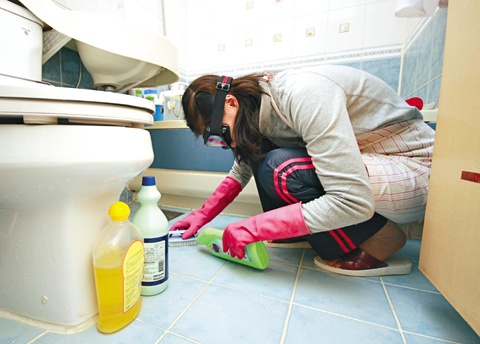
When you think clean, do you also imagine the odor of bleach? We all use bleach in some capacity. Bleach is a disinfectant and whitener/brightener. Maybe you use bleach in the laundry to remove stains, or with a mop to disinfect and clean the floor, or as a whitener in grout lines. Whatever the use, I bet you can close your eyes and practically smell bleach fumes right now.
A bleach smell is not a cleanliness test or a safety check. Bleach can have a place in a facility’s cleaning program, but the decision starts with the task, surface, product label, and people using the space. It should not start with how strongly a room smells afterward.
If your crew reaches for the same bottle for every job, take a closer look at the routine. Are they removing soil, sanitizing a food-contact surface, or disinfecting against a particular organism? Those are different jobs, and one set of directions will not cover all of them.
Choose the job before choosing the chemical
Start by writing down what the task needs to accomplish. A dirty floor needs soil removed. A surface covered by your facility’s disinfection procedure needs the specified treatment. Food-contact surfaces need products and procedures appropriate to that use.
For disinfection, check the actual product’s EPA registration and label. The EPA’s disinfectant guidance explains that effectiveness claims are specific to the registered product and its directions. A bottle’s active ingredient alone does not tell you whether it is approved for your surface, setting, or target organism.
Do not assume a laundry bleach and a registered disinfectant are interchangeable. For healthcare, food service, and child-care settings, use the applicable facility procedures and current requirements for that setting. If something is unclear, resolve it before the employee begins the task.
Read the instructions as a complete process
A dilution ratio is only one part of the job. Before putting a product into service, confirm:
- Where it belongs: the approved surfaces and uses, along with the surface manufacturer’s care instructions.
- What comes first: any required removal of soil or precleaning.
- How to prepare it: the product-specific dilution, measuring method, and preparation instructions.
- How to apply it: the labeled method and any restrictions.
- How to finish: the full wet contact time, any required rinse, and storage or disposal instructions.
The EPA directs users to follow the product label, including its contact time. Do not replace those directions with a recipe remembered from a different bottle. Our refreshed Action dilution guide can help your team understand measuring and mixing instructions; it does not replace the label.
Keep odor out of the pass-or-fail decision
A noticeable smell does not prove that the surface has been disinfected. A faint smell does not establish that the air is safe, either. The CDC’s chlorine guidance explains that effects depend on exposure and that prolonged exposure can affect a person’s ability to sense the chemical.
For a fuller discussion of respiratory risks, see our refreshed Are Bleach Fumes Dangerous? article. Here, the practical question is whether your facility has a workable process for the product it selected.
Never mix bleach with another cleaner or disinfectant. The CDC warns that mixing these products can release dangerous vapors. Adding a second chemical to a bucket is not a shortcut to a better result.
Make the process workable for every shift
Before assigning the task, review the label and safety data sheet with the employee. Check ventilation and required protective equipment, make sure containers are labeled, and show where the instructions are kept. OSHA and NIOSH’s cleaning-chemical guidance calls for training before workers use hazardous cleaning chemicals.
Ask the employee to demonstrate the preparation and application steps. Can the next shift repeat the same process? Can someone identify the contents of a secondary container without asking who filled it? Does the written procedure explain what to do if a spill occurs?
These questions belong in your broader workplace safety program. A product change should come with updated instructions and training, not just a new bottle on the shelf.
If someone develops irritation or a chemical mixture is suspected, stop the task, leave the affected area for fresh air, keep others away, and follow the facility’s emergency procedure. Do not stay to investigate the smell or try to neutralize a mixture. Seek urgent medical help for breathing difficulty.
Compare alternatives against the same requirements
Bleach is not the answer to every task, and a different product is not automatically harmless. Compare alternatives using the same questions: Does the label cover the job? Is it compatible with the surface? Can staff carry out the application and contact time? What handling, ventilation, and protective measures are needed?
Bring the product label, surface details, and current procedure to the conversation. That gives your supplier something useful to work with and helps keep the discussion focused on the job instead of a familiar smell.
ISSA offers additional cleaning-industry education. For help reviewing the products and routines in your facility, talk with Action Unlimited Resources. Start with one task that causes confusion, and work toward a process every shift can follow.
Questions or comments?